The Baseline is now approved and the planner updates periodically the status of activities in the time-schedule.
Planner’s tasks include also to update and record the productivities for the period and to compare the actuals against the planned outputs. This is a good practice: if departures occur then the accurate records are very useful to calculate the measured mile and also to corelate the outputs with the occurrence of the external causes impacting the works.
I choose as a simple example the construction of an RCC Dam, inspired from the Changuinola Hydropower project in Panama.
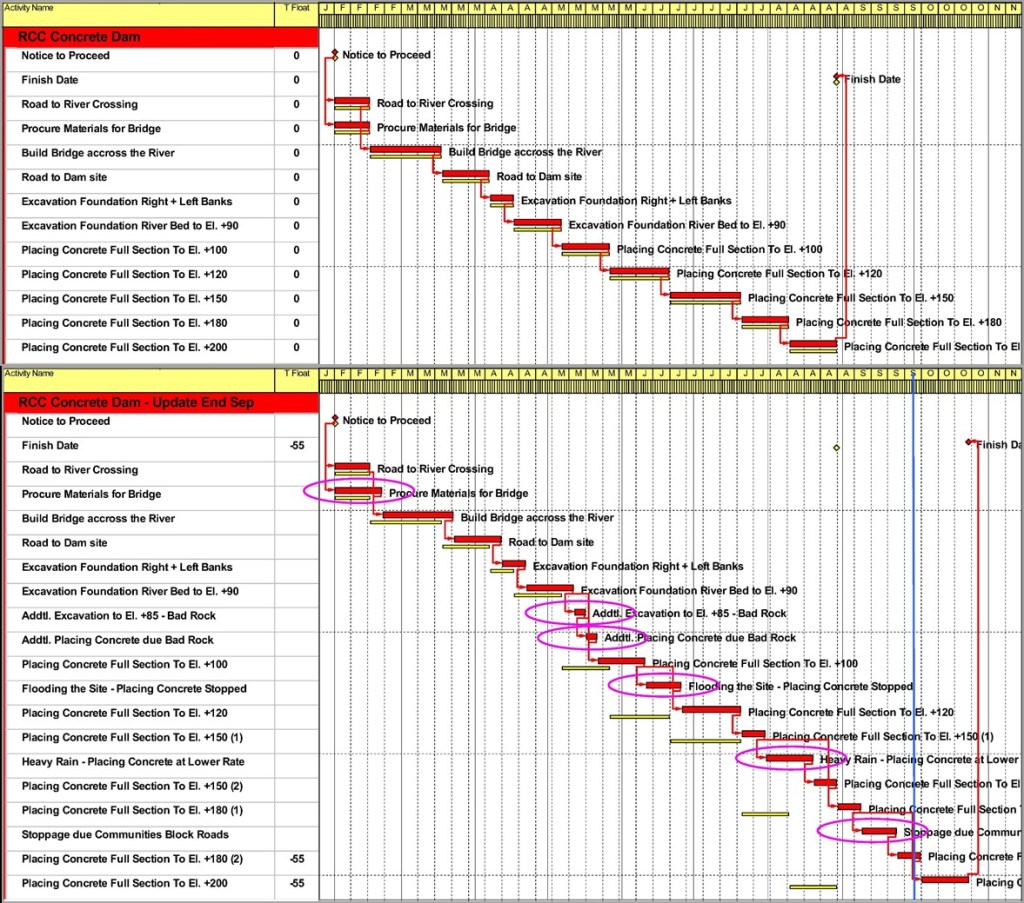
In the figure below are shown the two Critical Paths: above is the Baseline’s CP and below is the Updated Schedule CP (As built).
On the Updated Schedule are identified as well the events that generated delays to the Baseline’s CP, having a cumulative of 55 days of delay.
It is the planner’s task to calculate and demonstrate the disruption (lost of productivity), or prolongation and the subsequent entitlement to extra time. Only that the planner can do an accurate analysis with reliable results only when accurate contemporary records are available.
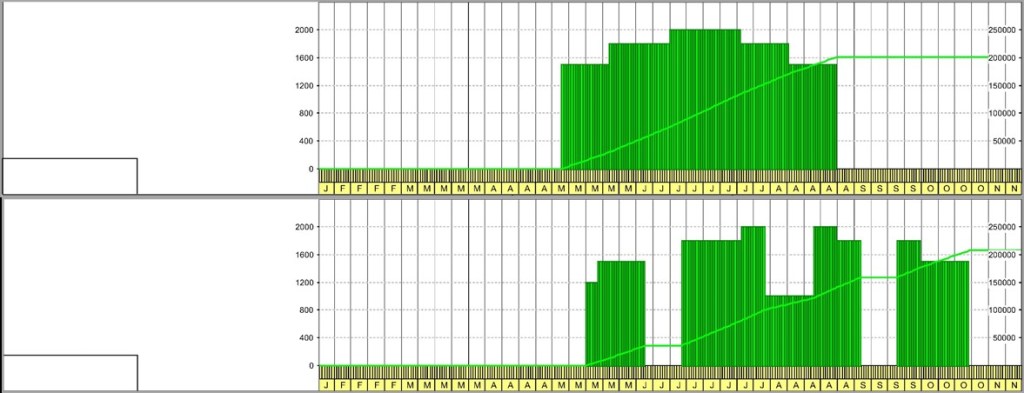
In the figure below are shown the daily histogram and cumulative curves for the Concrete quantities placed; above are the planned outputs and below are the actual outputs.
When the actual output histogram is analysed in conjunction with the Updated (As built) schedule a correlation will be done immediately between various delay events (e.g. Addt’l Excavation due Bad Rock and the late start of Concrete (RCC) placing, or Disruption created by the Heavy Rain that lead to a concrete placing productivity lower than planned, or Complete stoppage due Flooding or due to Local Communities actions). In the real life the Delay analysis may not be so straight-forward, however it will always be based on the contemporary daily records. If no records are available, the substantiation of any claim for disruption or delay can not be produced.
Another real life example of a construction project (Civil works and Concrete structure for a Data Center building) proves how non-advisable is to:
1. Produce a totaly unrealistic Baseline schedule, and
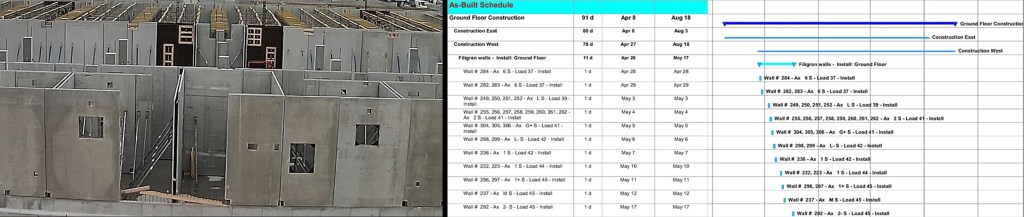
2. Not keeping any accurate and reliable contemporary daily records
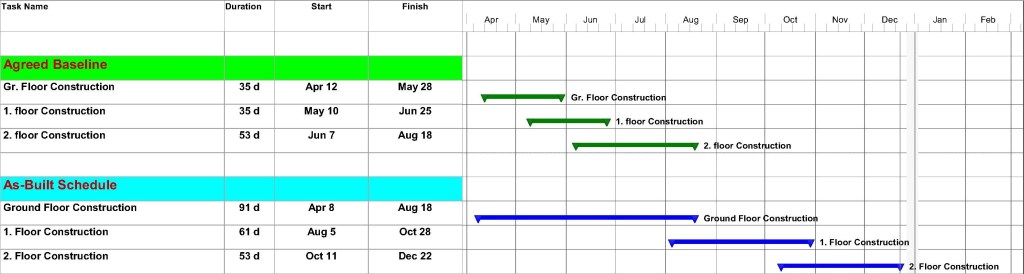
1. Figure below shows the comparison between the Agreed Baseline and the As built schedule (summary bars only).
The Baseline (green bars) was not produced by a qualified planner but by the project’s production manager; as in many other projects it was considered by the Contractor that having a dedicated planner on site is just wasting money. The result was a completely unrealistic time-schedule where works for the 1st and 2nd floor were planned to start before deck slab over the Ground floor and 1st floor respectively were even started! And so appeared the long overlapping periods that lead to an early and very optimistic end date, by mid August. The Client did not object and the Baseline schedule was agreed.
Further explanations / comments still to be added.
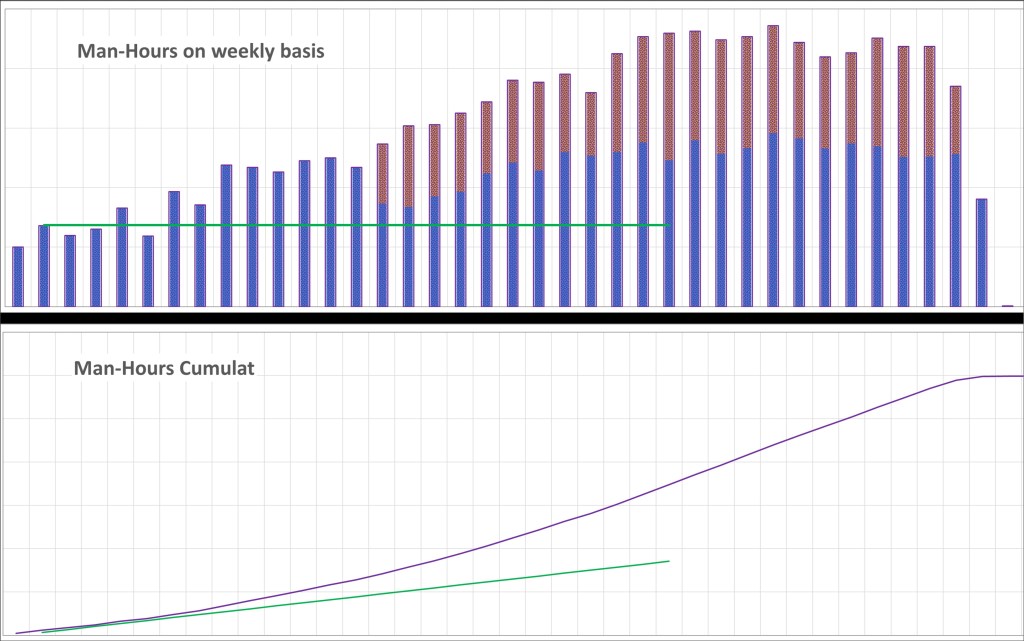
Below is an example of how lower quality of site reports of outputs impacts the quality of the Delay Analysis. Example is taken from a Road project in Tanzania, Filling works.
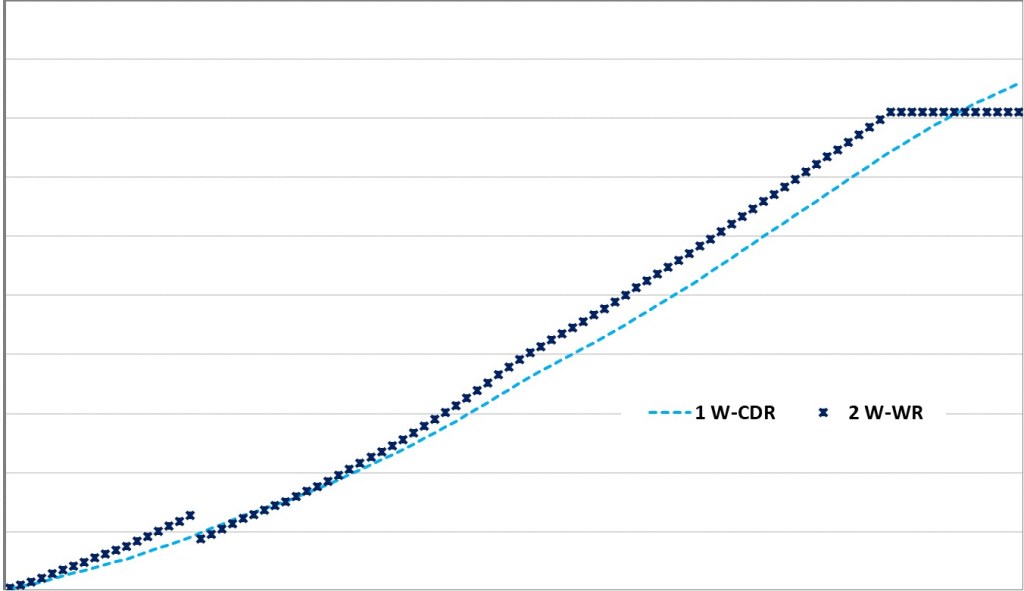
I found out that between the cumulative quantities from the Weekly reports do not coincide with the ones from the Monthly reports. I decided to look at the Daily reports starting from four years before to build cumulative progress curve based on Daily reports and then to compare with the curve from Weekly and Monthly reports respectively.
Curve no. 1 is the cumulative weekly from the Daily reports, Curve no. 2 is the cumulative weekly from the Weekly reports. Should point out again that the two curves describe the same work in the same project and therefore they should be identical, but they are not.
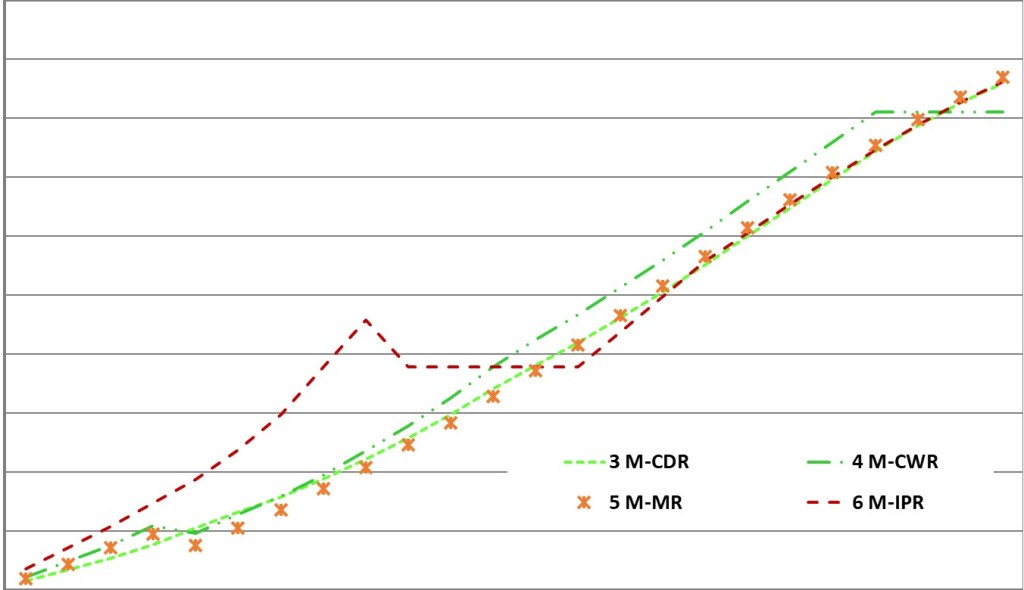
Here below Curve no. 3 is the cumulative monthly from Daily reports, Curve no. 4 is the cumulative monthly from the Weekly reports, Curve no. 5 is from the Monthly reports and Curve no. 6 is from the Interim Payment Application (Monthly). None of them is identical with any of the other three.
With reports of such a poor quality there has been no expectation to support a successful disruption and prolongation claim.
For any inquires, feel free to email me at rt@why-planning.com
 Why-Planning